6-8th Grade Science - MS-PS1-5 - Where Do the Atoms Go? Modeling Chemical Reactions
6 Questions
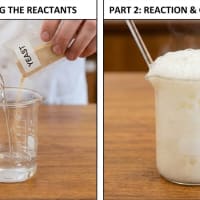
In the photos, a student mixes hydrogen peroxide and yeast in an open beaker and bubbles form.
Students react baking soda and vinegar in a sealed plastic bag. Bubbles form in the bag as the reaction happens. They measure mass before and after.
Hydrogen gas and oxygen gas react to form water. The equation below is a model of the reaction.
A gas stove burns methane (natural gas) in oxygen from the air, producing carbon dioxide and water vapor. The equation below is a model of the reaction:
A class is checking whether each representation follows conservation of atoms.
A student puts steel wool (iron) in a sealed jar with air.
We help forward-thinking Californian districts achieve significant CAASPP score improvements in Science, Language Arts, and Math. Our NGSS-aligned questions ask students to analyze, model, and reason through real-world science challenges.
Learn more