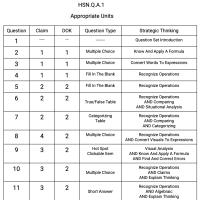
N.Q.A.1 - Appropriate Units
11 Questions
N.Q.A.1 - Appropriate Units Introduction
The formula for the voltage in a circuit is V = IR where
Eric is dreading going to his aunt's house for three whole days. He actually calculates how much time he will have to spend there to the minute.
Ella made a scale model of her backyard. The backyard, which is 176 meters long in reality, is 44 millimeters long in the model.
The school cafeteria uses 20 gallons of milk each day. Each quart of milk costs $1.25.
Which of the following statements about the scenario below are true and which are false?
Determine the scale factor of each of the models below and indicate if the scale factor is less than 10 units, equal to 10 units, or greater than 10 units.
Identify the expression for the image below showing the difference in volume of the two beakers in liters.
Below is a table showing the relationship between the volume of different containers (in liters) and the mass of the liquid they contain (in kilograms).
You and a friend are heading to the beach. You are currently traveling at 50 miles an hour. Your friend, Leticia, says the beach is 10 miles away.
A bakery has developed its own blend of flour for making bread.
We help districts in California boost CAASPP Math Scores by Δ +20% by helping teachers determine if students are struggling with the content, the technology involved with the type of question, or the type of strategic thinking required. Based on the 8 Standards for Mathematical Practice, our platform and professional development empowers teachers to recognize all 16 types of strategic thinking across any math question, curriculum, or assessment.
Learn more