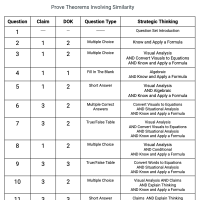
G.SRT.4 and G.SRT.5 - Prove Theorems Involving Similarity
11 Questions
G.SRT.4 and G.SRT.5 - Prove Theorems Involving Similarity
Consider two right triangles.
Use the diagram below to answer the question.
Triangles ABC and DEF are similar.
Triangles ABC and DEF are shown below.
Triangles ABC and DEF are similar.
Triangle ABC is shown.
For triangle EFD, the following relationships are true:
Students measure a tree’s height using shadows on two different days.
Triangle ABC is shown.
Nestor makes the following claim:
We help districts in California boost CAASPP Math Scores by Δ +20% by helping teachers determine if students are struggling with the content, the technology involved with the type of question, or the type of strategic thinking required. Based on the 8 Standards for Mathematical Practice, our platform and professional development empowers teachers to recognize all 16 types of strategic thinking across any math question, curriculum, or assessment.
Learn more