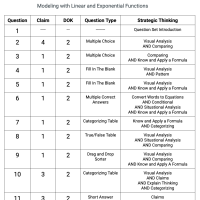
F.LE.A.1a, b, c and F.LE.A.3 - Modeling with Linear and Exponential Functions
11 Questions
F.LE.A.1a, b, c and F.LE.A.3 - Modeling with Linear and Exponential Functions
Two revenue models (in thousands of dollars) for a subscription product are proposed:
A device’s battery charge is checked each hour. Two models describe different charging/usage behaviors (t in hours):
Use the table below to determine the value of y when x = 4.
A school club tracks followers on its official page each week. Where x is the number of weeks after the start of the school year and y is the total number of followers.
A bank offers a sign-up special for savings accounts, compounded annually:
For each situation, choose the function (D, L, or E) that best models it. Assume equal increments of time.
The graph shows two functions, f and g.
Each table shows a function with equal increments in x.
Two students are modeling the same data set. The table shows how a quantity y changes with x:
Ana is analyzing the two functions shown below.
We help districts in California boost CAASPP Math Scores by Δ +20% by helping teachers determine if students are struggling with the content, the technology involved with the type of question, or the type of strategic thinking required. Based on the 8 Standards for Mathematical Practice, our platform and professional development empowers teachers to recognize all 16 types of strategic thinking across any math question, curriculum, or assessment.
Learn more