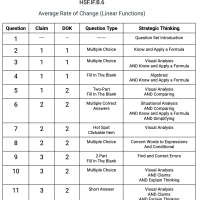
F.IF.B.6 - Average Rate of Change (Linear Functions)
11 Questions
F.IF.B.6 - Average Rate of Change (Linear Functions)
A company's monthly cost C(n) (in dollars) is a linear function of the number of active users n (in thousands).
The table shows values of a linear function f.
In a lab, the mass p(t) (grams) of a sample is a function of time t (seconds).
Two functions are shown in the graphs below.
Assume f is linear and defined on the interval.
A bathtub’s water level V(t), in liters, is shown as a function of time t, in minutes.
A school fundraiser tracks total donations D(t) in dollars, where t is hours after 8:00 AM.
Find the error in the student's work.
The table shows the mass M(t) (grams) of a newly hatched chick, where t is days after hatching.
The distance from home, S(t) (miles), during a student’s commute is recorded at the times below, where t is minutes after leaving home.
We help districts in California boost CAASPP Math Scores by Δ +20% by helping teachers determine if students are struggling with the content, the technology involved with the type of question, or the type of strategic thinking required. Based on the 8 Standards for Mathematical Practice, our platform and professional development empowers teachers to recognize all 16 types of strategic thinking across any math question, curriculum, or assessment.
Learn more