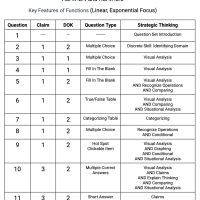
F.IF.B.4 and F.IF.B.5 - Key Features of Functions (Linear, Exponential Focus)
11 Questions
F.IF.B.4 and F.IF.B.5 - Key Features of Functions (Linear, Exponential Focus)
A sensor records the temperature of a liquid, T(t), from the instant heating begins until it returns to room temperature 8 minutes later.
Select the graph that shows the volume of water y (liters) in a tank after x minutes when water flows in at a constant rate of 3 liters per minute.
The function p(t) gives the population (in thousands) of a culture of bacteria t days after it is started.
Over a number of days, the water level in two pools varies as water evaporates and then is refilled.
For each statement, select True or False.
For each context, choose the domain for the input variable as it is used in the model.
Ruben is planning a party and has at most $100 to spend on snacks.
A function p is defined by the following:
A school club tracks its funds F(t) in dollars, where t is weeks after the start of the school year.
A lab tracks the temperature of a solution with a sensor from the moment heating begins until it cools back to room temperature 6 minutes later.
We help districts in California boost CAASPP Math Scores by Δ +20% by helping teachers determine if students are struggling with the content, the technology involved with the type of question, or the type of strategic thinking required. Based on the 8 Standards for Mathematical Practice, our platform and professional development empowers teachers to recognize all 16 types of strategic thinking across any math question, curriculum, or assessment.
Learn more