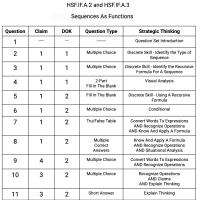
F.IF.A.2 and F.IF.A.3 - Sequences As Functions
11 Questions
F.IF.A.2 and F.IF.A.3 - Sequences As Functions
Which of the following is an arithmetic sequence?
Which of the following defines the sequence shown in the table using a recursive formula?
The sequence shown below is geometric.
A sequence is defined recursively by the following rule:
Which option satisfies all three of the following criteria?
A student receives a 15-minute detention for each time they are tardy to class.
Which of the following statements about the scenario below are correct?
Choose the graph that best matches the domain and growth pattern described.
The sequence below follows a pattern:
A sequence is defined in two ways:
We help districts in California boost CAASPP Math Scores by Δ +20% by helping teachers determine if students are struggling with the content, the technology involved with the type of question, or the type of strategic thinking required. Based on the 8 Standards for Mathematical Practice, our platform and professional development empowers teachers to recognize all 16 types of strategic thinking across any math question, curriculum, or assessment.
Learn more