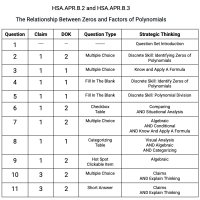
APR.B.2 and APR.B.3 - The Relationship Between Zeros and Factors of Polynomials
11 Questions
APR.B.2 and APR.B.3 - The Relationship Between Zeros and Factors of Polynomials
Which statement must be true based on the factorization below?
Select the answer that best completes the following statement:
The graph of the polynomial function f(x) is shown below.
f(x) is shown below.
Consider the two polynomials below:
Exactly one of the polynomials p(x) below satisfies all three criteria.
Match each function to the correct statement in the table below.
Click on the value of a that makes x – 2 a factor of p(x).
A student makes the following claim about polynomial functions:
Jordan notices that when the polynomial p(x) is divided by x, the remainder is 1.
We help districts in California boost CAASPP Math Scores by Δ +20% by helping teachers determine if students are struggling with the content, the technology involved with the type of question, or the type of strategic thinking required. Based on the 8 Standards for Mathematical Practice, our platform and professional development empowers teachers to recognize all 16 types of strategic thinking across any math question, curriculum, or assessment.
Learn more